Computer Engineer · Builder · Researcher

Engineering ideas
from signal to system.

I'm Gabriel, a computer engineering student designing at the intersection of embedded systems, power electronics, and production software.

Current focus

Embedded systems research

Hardware · Firmware · Tools

Based in Newport News, VirginiaScroll to explore

01 / About

I like the layer where software meets the physical world.

I'm pursuing a B.S. in Computer Engineering and a minor in Mathematics at Christopher Newport University, graduating in 2027—and looking for full-time roles starting May 2027.

My work moves between circuit boards and code: laying out high-current power systems, writing firmware for constrained devices, and building reliable software infrastructure. I'm especially interested in embedded systems, power delivery engineering, and applied hardware research.

Alongside school, I've spent more than three years growing from intern to lead software engineer at Core4ce—experience that taught me how to carry technical work from early architecture through production deployment.

02 / Research

Selected hardware, AI & research projects.

Designing, testing, and iterating from first principles.

01 · Grant-funded development platform

CNU Summer Scholars · Core4ce grant · Jun—Jul 2025

Tardis

A modular embedded-AI development kit that pairs an MCU system-on-module (built around the Nordic nRF54LM20B) with an AI accelerator on a single, easy-to-breakout carrier board—making edge AI approachable for developers with less hardware experience.

I proposed the project, applied for and secured grant support from Core4ce through CNU's Summer Scholars program, then independently designed, assembled, and brought up the complete system with guidance from a faculty mentor. My work spanned system architecture, custom hardware, embedded software, and developer tooling, with an emphasis on hiding platform complexity without sacrificing flexibility.

Company-supported · Selected details
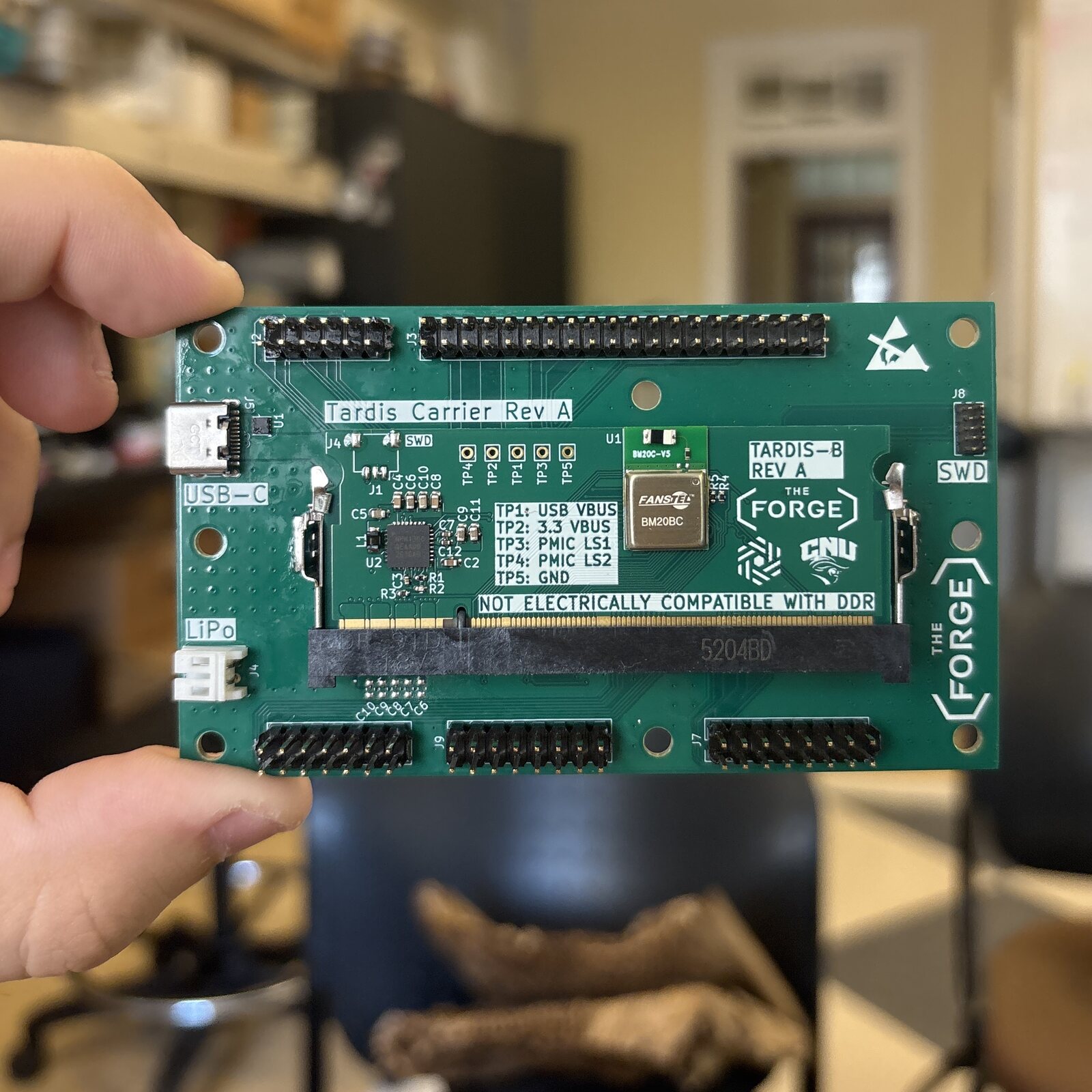
Tardis compute module installed in its custom development carrier
Development carrier prototype
01

Independently designed end to end

02

Modular custom hardware and bring-up

03

Firmware and tools that abstract platform complexity

04

Designed around nontechnical users

02

Senior capstone · Team of two · In progress

BLE Sensor Network & Parallel Test Fixture

My senior capstone, built with a teammate: an anonymized, privacy-by-design BLE sensor network for commercial and school deployments, engineered so a single node failure degrades coverage only locally rather than taking down the network, and so no individual can be identified or tracked even if a node is compromised. Each nRF-based node targets roughly six months of battery life. The deployment is paired with a custom test fixture that tests and programs a full 16-DUT panel in under two minutes at a target failure rate below 1 in 1,000, using a Raspberry Pi to orchestrate 16 independent, per-DUT MCUs over a bed-of-nails interface, with eFuse-isolated soft-start and per-rail short/voltage checks ahead of test and production firmware flashing. Every major module (power, per-DUT MCU, DUT interface) is field-swappable without soldering, and the whole rig runs from a Pi-hosted web UI instead of an onboard display. If funding comes through, the goal is to build and demo a fleet of 50+ nodes.

  • Anonymized BLE network—no individual tracking
  • Node-independent: a single failure stays local
  • nRF-based node, ~6-month battery life
  • 16 independent per-DUT MCUs, bed-of-nails interface
  • 16-board panel tested & programmed in <2 min
  • Field-swappable modules, Pi-hosted web UI
03

Exploratory design · On hold

RPi CM5 ATX Carrier Board

An exploratory 8-layer, nano-ATX carrier design for the Raspberry Pi Compute Module 5, developed around high-current power delivery, per-rail telemetry, and embedded supervision. The project is currently on hold.

  • TPS544B27W buck converters
  • 10A per-rail telemetry
  • ESP32 supervisory firmware
  • Controlled-impedance stackup
04

Active unpublished research · Sept 2025—Present

Air Sentry Neo

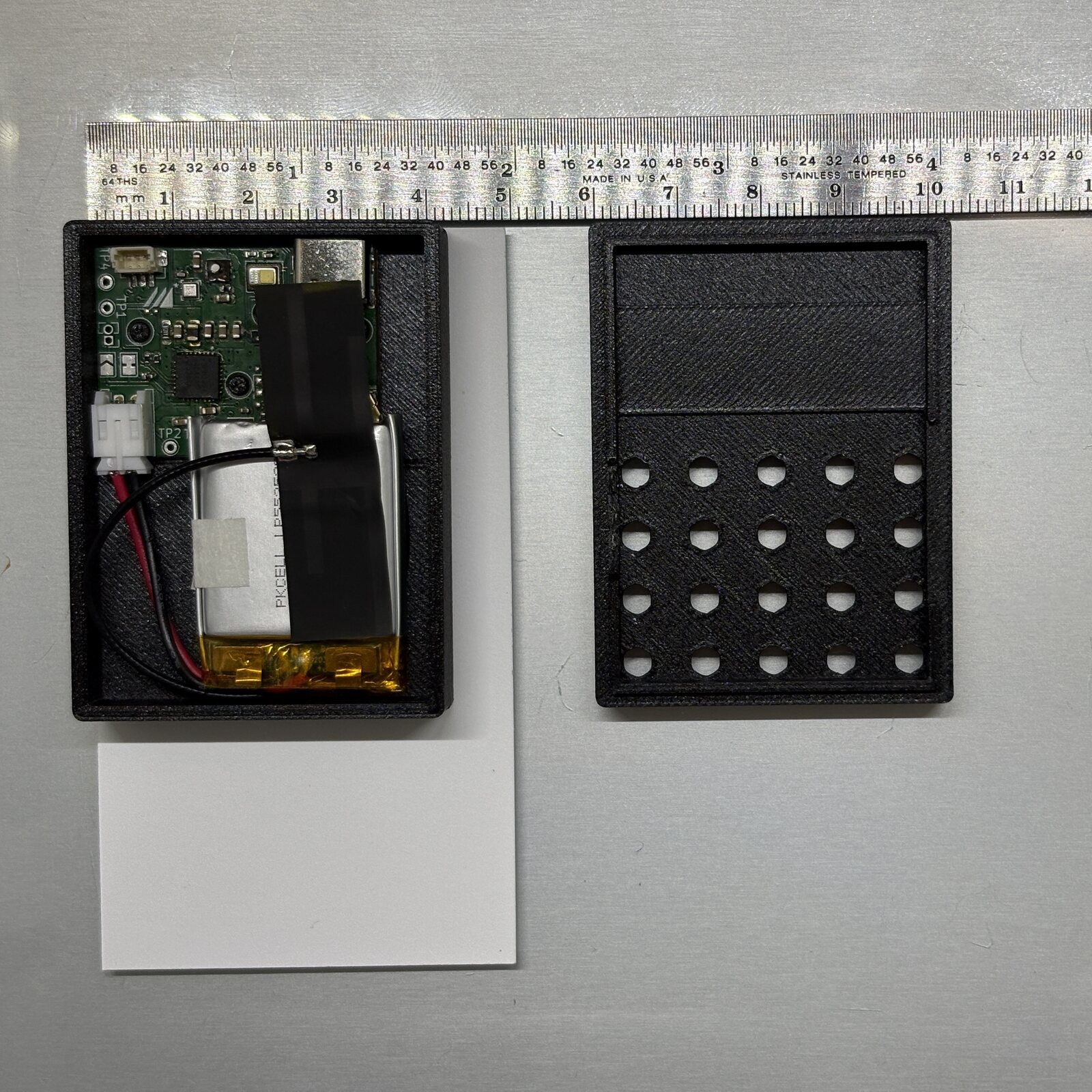
I independently own this indoor air-quality research platform end to end—architecture, PCB layout, firmware, and experimental design. It integrates five sensors over I2C with onboard SPI flash logging and BLE connectivity, housed in a custom enclosure and engineered to run more than two weeks on a single 350mAh battery. Technical methods and results remain limited while the research is unpublished.

  • Five I2C sensors + SPI flash logging
  • BLE connectivity
  • 2+ weeks on a 350mAh battery
  • Custom enclosure design
Air Sentry indoor air-quality monitor with its enclosure opened
Prototype hardware · Details limited
CNU

University research · 2023—2025

Super BigByte Project

Explored CNC fabrication of table-sized PCBs and assembled key power-delivery systems for the project's photo-multiplier coordinate detector.

03 / Professional

Building software that holds up in production.

LinkedIn

Core4ce

Reston, Virginia

June 2022 — Present

Software R&D Intern → Software Engineer → Lead Software Engineer

  • 01

    Designed a production data pipeline in Apache NiFi on AWS, including custom Java processors and reconfigurable routing.

  • 02

    Led the end-to-end development of Cyberscape, owning architecture, sprint planning, client deployments, and mentorship.

  • 03

    Overhauled testing for a critical subsystem and expanded data-forensics capabilities with Django, Docker, and AWS.

Languages

Python, C, C++, Java, C#, Z80 Assembly

Hardware & systems

PCB Layout, KiCad, SystemVerilog, PMBus, power delivery

Embedded platforms

ESP32 / ESP-IDF, Nordic nRF52 & nRF54, Zephyr / NCS, ESPHome

Frameworks & tools

Docker, Apache NiFi, Django, Git, AWS

04 / Personal

Always making something.

Outside of classes and client work, I'm usually prototyping hardware, 3D printing, or helping other students turn an idea into something they can hold.

Early project · High school

02

Z80 Microcomputer

In high school, I designed an 8-bit Z80-based computer and wrote a minimalist operating system in assembly with basic I/O and memory routines.

High school · Computer architecture · Z80 assembly

Current obsession

03

Power, measured well.

Exploring how thoughtful power architecture, telemetry, and fault handling can make ambitious embedded systems more observable and reliable.

PMBus · PCB design · Firmware

Open source

04

Code & build logs

Follow along with experiments, hardware revisions, and the software that supports them on GitHub.

Visit GitHub

Have an interesting problem?

Let's build something that works.

Open to full-time roles · Starting May 2027

gabriel.womelsdorf.work@gmail.com